Help us to establish Drala Jong - a Buddhist Retreat Centre in Wales

Help us to establish Drala Jong - a Buddhist Retreat Centre in Wales

Monday, 17 October 2022

Boredom marks the beginning of realisation

Once you develop experience of shi-nè, boredom is no longer boredom – it becomes a rolling wave of energy.  So, boredom marks the beginning of realisation.  Without boredom there’s no discovery.

p81, Tracts of the Sun : An Earth Orbit of Vajrayana Expressions.  Ngakpa Chögyam and Khandro Déchen, Aro Books, 2022, ISBN 978-1-898185-28-4

Monday, 10 October 2022

Boredom

Boredom is a sign that: one is not alive to one’s senses.

p81, Tracts of the Sun : An Earth Orbit of Vajrayana Expressions.  Ngakpa Chögyam and Khandro Déchen, Aro Books, 2022, ISBN 978-1-898185-28-4

Monday, 3 October 2022

Wind Horse

rLung rTa—Wind Horse—is enjoyment.  Enjoyment means to occasion or to engender joy.  Joy is upliftedness – the natural response to phenomena and to being alive.

p30, Tracts of the Sun : An Earth Orbit of Vajrayana Expressions.  Ngakpa Chögyam and Khandro Déchen, Aro Books, 2022, ISBN 978-1-898185-28-4

Monday, 26 September 2022

Anarchy

Anarchy from the perspective of Dzogchen has nothing to do with rebellion or overturning the social order – one simply needs to ignore the rules of cyclic derangement.

p29, Tracts of the Sun : An Earth Orbit of Vajrayana Expressions.  Ngakpa Chögyam and Khandro Déchen, Aro Books, 2022, ISBN 978-1-898185-28-4

Monday, 19 September 2022

Eventual death

Falling in love—if it is authentic love—betokens the eventual death of the ‘me project’.

p75, Tracts of the Sun : An Earth Orbit of Vajrayana Expressions.  Ngakpa Chögyam and Khandro Déchen, Aro Books, 2022, ISBN 978-1-898185-28-4

Tuesday, 13 September 2022

Enjoying their presence

Kindness is inseparable from appreciation and enjoyment.  If one likes people, one will be kind in relation to them.  One cannot like people without appreciating them – without enjoying their presence.

p67, Tracts of the Sun : An Earth Orbit of Vajrayana Expressions.  Ngakpa Chögyam and Khandro Déchen, Aro Books, 2022, ISBN 978-1-898185-28-4

Monday, 5 September 2022

The interface with the sense fields

The arts are bodhicitta.  The connection is quite clear; especially when you look at the level of humanitarianism among artists.  Beyond that however, one has the interface with the sense fields as the arena in which bodhicitta communicates.

p176, Emailing the Lamas from Afar, Ngakpa Chögyam and Khandro Déchen, Aro Books, 2009, ISBN 978-0-9653948-5-7

Monday, 29 August 2022

An entire gestalt

Naming moments of inspiration as Padmasambhava and Yeshé Tsogyel is not a question of conceptualisation for a practitioner because Padmasanbhava and Yeshé Tsogyel are not concepts,  They are an entire gestalt, which is both conceptual and non-conceptual.

p166-167, Emailing the Lamas from Afar, Ngakpa Chögyam and Khandro Déchen, Aro Books, 2009, ISBN 978-0-9653948-5-7 

Monday, 22 August 2022

Active compassion

Active compassion, changchub sem (byang chub sems—or bodhicitta), could be expressed as: appreciative empathetic appreciation.  The term changchub sem is vast, subtle, and infinitesimally varied in its meaning, according to the endless permutations of sentience dancing with phenomenal reality.

p114, Emailing the Lamas from Afar, Ngakpa Chögyam and Khandro Déchen, Aro Books, 2009, ISBN 978-0-9653948-5-7 

Monday, 15 August 2022

All of my own making

My situation now—and in the future—would also be all of my own making.  The only realistic mental state was openness to the future – and to whatever the future held.

p340, Goodbye Forever Vol. II, Ngakpa Chögyam, Aro Books Worldwide, 2021, ISBN 978-1-898185-60-4


Monday, 8 August 2022

Discovering the nature of reality

“ ... I made the distinction between Truth and reality.  I don’t see Buddhism as owning ‘truth’ – because Buddhism isn't a religion of ‘truth’.  It’s a religion of ‘method’ – and, its methods are ways of discovering the nature of reality.”

p177, Goodbye Forever Vol. II, Ngakpa Chögyam, Aro Books Worldwide, 2021, ISBN 978-1-898185-60-4


Monday, 1 August 2022

The words of Dud’jom Rinpoche

I remembered the words of Dud’jom Rinpoche ‘With each life circumstance: whatever is enacted, stare directly into the enactment – with all the senses.

p194, Goodbye Forever Vol. II, Ngakpa Chögyam, Aro Books Worldwide, 2021, ISBN 978-1-898185-60-4

Monday, 25 July 2022

The mechanism of samsara

We do not get stuck in reference points.  We create them and suffer as they collapse and cease to be reference points.  All you can do is ‘be as open as possible to all possibilities’ whilst observing the mechanism of samsara as you play it out.

p81, Emailing the Lamas from Afar, Ngakpa Chögyam and Khandro Déchen, Aro Books, 2009, ISBN 978-0-9653948-5-7 


Monday, 18 July 2022

Fleeting glimpse

We say ‘only a nyam’ because a nyam is not the nondual state, but one can experience the nondual state momentarily, and the afterglow of that is called a nyam.  This does not detract from there having been a fleeting glimpse of the nondual state.

p87, Emailing the Lamas from Afar, Ngakpa Chögyam and Khandro Déchen, Aro Books, 2009, ISBN 978-0-9653948-5-7  

Monday, 11 July 2022

Open and embodied

Discovering the nondual state is not a process of internalisation.  We do not cut off from the external world.  Everything we see, hear, smell, taste, touch, or ideate is undivided from the nondual state – so, to be present, is to be entirely open and embodied.

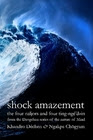
p83, Shock AmazementThe four naljors and four ting-ngé’dzin from the Dzogchen series of the nature of Mind.   Khandro Déchen and Ngakpa Chögyam,  Aro Books Worldwide, 2018, ISBN 978-1-898185-45-1 

Monday, 4 July 2022

Freedom to manifest

When we dissolve shi-nè—and allow the natural energy of Mind to re-emerge from emptiness—we are not creating anything – we are simply allowing.  As soon as energy begins to re-emerge, all that is necessary is to allow that energy the freedom to manifest.

p52, Shock AmazementThe four naljors and four ting-ngé’dzin from the Dzogchen series of the nature of Mind.   Khandro Déchen and Ngakpa Chögyam,  Aro Books Worldwide, 2018, ISBN 978-1-898185-45-1 

Monday, 27 June 2022

Change the world

We can definitely change the world – but the problem is that we often seem unable to smile.  When chaos manifests in our lives we can smile – which is the cure for resentful confusion. 

p241, Emailing the Lamas from Afar, Ngakpa Chögyam and Khandro Déchen, Aro Books, 2009, ISBN 978-0-9653948-5-7  

Monday, 20 June 2022

Obsessive relationship

To investigate the nature of thought – we need to use some capacity other than thought.  In order to discover what other means there are at our disposal to investigate the nature of thought we need to detach from obsessive relationship with thought. 

p48, Shock AmazementThe four naljors and four ting-ngé’dzin from the Dzogchen series of the nature of Mind.   Khandro Déchen and Ngakpa Chögyam,  Aro Books Worldwide, 2018, ISBN 978-1-898185-45-1 

Monday, 13 June 2022

A closed system

Thought cannot examine itself in any ultimate sense – it is a closed system.  Thought can no more examine its own nature than a knife can cut itself, or an eye see itself.  The only way an eye can see itself is to avail itself of a mirror.  The nature of that mirror—vis à vis thought—is the natural reflective capacity of Mind, which is beyond thought.

p48, Shock AmazementThe four naljors and four ting-ngé’dzin from the Dzogchen series of the nature of Mind.   Khandro Déchen and Ngakpa Chögyam,  Aro Books Worldwide, 2018, ISBN 978-1-898185-45-1 
Monday, 6 June 2022

Gazing

We can consider the possibility of gazing at the glittering surface of the ocean of Mind – at sun-light and star-light glinting.  Gazing is an openness which sees—with transparence— the nature of our relationship with reference points.

p43-44, Shock AmazementThe four naljors and four ting-ngé’dzin from the Dzogchen series of the nature of Mind.   Khandro Déchen and Ngakpa Chögyam,  Aro Books Worldwide, 2018, ISBN 978-1-898185-45-1